

What Makes Forró Recognizable as Forró? Language, Style, and Individuality in Dance

Updated: Jun 13
How much does the freedom to express individuality affect our ability to recognize a language?
This is a question I have been asking myself since I began teaching forró in New York.

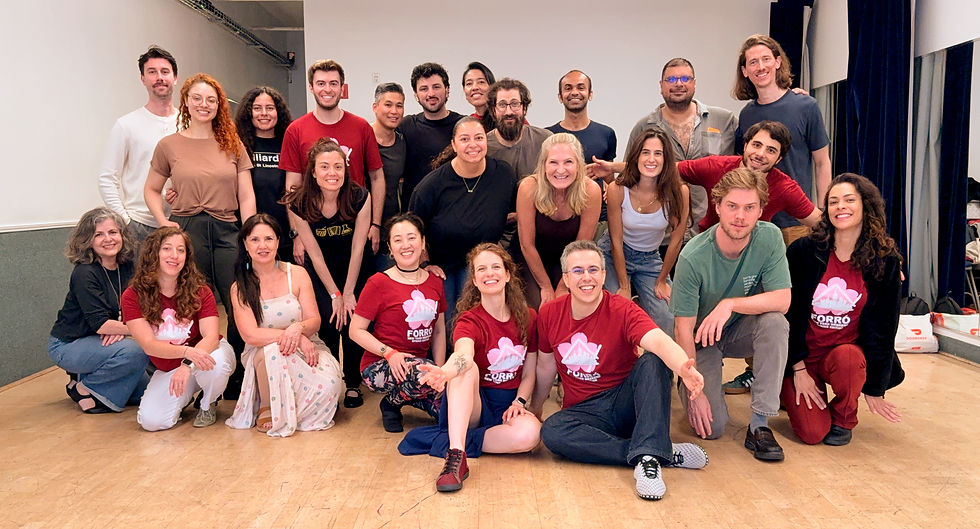
Over the years, I have welcomed students from different countries, cultures, and dance backgrounds. Some came from salsa, others from tango, swing, ballroom, contemporary dance, or simply with no previous social dance experience at all. Each person brought their own way of listening to music, occupying space, relating to touch, and using their body.
Part of teaching forró involves introducing movements, concepts of musicality, and ways of interacting within the dance. But there is a less obvious dimension to this process: helping students understand a specific body language.
This has always been a delicate balance. On one hand, I did not want to convey the idea that there is only one correct way to dance forró. On the other hand, it never seemed sufficient to say that any way of moving could be considered forró.
Over time, I realized that this question goes far beyond dance. It touches on something present in almost every form of human expression: how does a language maintain its identity without giving up the individuality of those who use it?
The Paradox of Every Language: Identity and Freedom
The more I think about this question, the more I realize it does not belong only to dance.
A musician can play jazz in ways that are radically different from another musician. A writer can develop a unique voice without ceasing to write in English. A cook can reinterpret a traditional recipe without making it unrecognizable.
In all of these cases, there is a constant negotiation between what we inherit from a tradition and what we bring as individuals.
Dance seems to deal with exactly the same question.
No two people speak in exactly the same way. Yet there are shared characteristics that allow us to recognize a language as English, Portuguese, or French.
In jazz, two improvisers may sound completely different from one another. Yet there is a common language that allows us to recognize that music as jazz.
The same is true in dance.
No forró dancer dances exactly like another. No school teaches in exactly the same way. No city develops exactly the same habits. Yet there is something that allows us to watch certain people dancing and recognize what we are seeing as forró.

What Happens When We Learn a New Dance Language?
Recently, a Brazilian couple came to one of my classes with an interesting story.
They had learned swing in Brazil, moved to New York, and were now looking for forró as a way to reconnect with Brazilian culture.
From the very first minutes, it was obvious that they already had significant experience in social dancing. They had rhythm, coordination, body awareness, and a clear understanding of the dynamics between leading and following. They learned movements much faster than most beginners.
But it was also impossible not to notice the presence of swing in the way they moved.
There were traces of Balboa in the way they marked the pulse and organized their posture. At other moments, elements more closely associated with Lindy Hop appeared, such as certain patterns of elasticity and a tendency to project energy backward. Some footwork embellishments also clearly belonged to that language.
None of this was a problem.
In fact, those characteristics were evidence of the experience they already had.
But the situation raised an interesting question: to what extent were those traits part of their individuality, and to what extent were they features of another language being carried into forró?
Accents Exist in Dance Too
The best way I have found to understand this phenomenon is to think about accents.
When someone learns a second language, they do not start from zero. They bring habits, rhythms, sounds, and patterns acquired through their first language.
Something similar happens in dance.
After several years of teaching, I began to realize that I can often identify a dancer’s background before they tell me their story.
With students coming from salsa, this often happens within the first embrace. Before we even begin dancing, I can already feel a tendency to transfer communication into the arms and to maintain more distance between the bodies. Within the first few steps, movements of the shoulders and hips emerge that are part of the movement vocabulary developed through that dance.
With tango dancers, the feeling is usually different. There is often a quietness in the way they enter the embrace. The connection is concentrated in the upper part of the embrace. They organize their balance and posture differently. There is often a certain neutrality in the body and a distancing from the hips and legs.
With students coming from Zouk, I tend to notice other characteristics. There is often greater flexibility in the body’s axis, a high degree of fluidity in movement, and a tendency to create waves throughout the body. In many cases, there is also a more backward-set hip position. These are characteristics of that particular language that often remain present when someone begins learning forró.
None of these characteristics appear by accident.
They are evidence of years spent practicing another language.
The Problem Isn’t the Movement. It’s the Habit.
Over the years, I have realized that I am rarely correcting specific movements.
Most of the time, I am observing patterns.
One story that illustrates this well involved a student who had a habit of using hip movement in a very pronounced and constant way.
The problem was not the movement itself.
The problem was that the choice appeared almost all the time.
Certain connections became more difficult to establish. Some movements lost efficiency. Certain possibilities simply stopped existing because the body was constantly returning to the same pattern.
For a long time, I tried to help her explore other options.
My goal was never to eliminate the use of the hips. On the contrary. The idea was to expand her range of possibilities.
But she interpreted those conversations differently.
From her perspective, I was telling her that moving her hips was somehow wrong.
Years later, during a festival, a guest instructor taught a class that included exactly that kind of hip movement. At one point, I saw this student looking at me from across the room with an expression that seemed to say:
“See? She’s using her hips.”
The situation was amusing because it made it clear that we had spent years talking about slightly different things.
That instructor used hip movement as part of a broad vocabulary.
My student wanted to use that same tool all the time.
Expression or Habit?
Over time, I came to realize that this distinction is one of the most important parts of the learning process.
There is a difference between a conscious aesthetic choice and a habit that is repeated automatically.
If a movement appears in response to the music, an interpretation, or a specific intention, we are talking about expression.
But when the same movement appears continuously, regardless of the music, the partner, or the context, it stops feeling like a choice and it begins to function on autopilot.
That is why one of the phrases I use most often in class is:
“What you’re doing isn’t wrong. But can I suggest something different for you to try?”
Many times, I ask students to temporarily reduce precisely the thing they do most naturally.
Not because it is wrong.
But because when a dominant tendency is reduced, other possibilities begin to emerge.
Some Things Are Taught. Others Are Absorbed.
There is another aspect of body language that fascinates me. Not everything is learned through instruction.
When I started teaching forró in New York, some Brazilian friends who were already active in the local community began to notice that many students were developing a way of moving that was relatively similar to my own.

It was not a matter of reproducing the same movements. What began to appear was a similarity in movement quality and in certain movement characteristics that are rarely taught explicitly.
The observation caught my attention because it did not come from someone analyzing the dance technically. It came from people who had simply been part of that community for years and noticed that something was changing.
It made me think about how certain characteristics are transmitted without anyone explicitly explaining them.
I see this constantly.
When students move beyond the beginner stage and start dancing regularly with more experienced dancers, something begins to change.
It is not the kind of change that usually happens from one week to the next. But a few months later, I often notice that their body language is different, that the way they occupy space has changed, or that certain movements begin to happen more naturally.
I also observe this when students attend festivals or intensive forró weekends, where they end up dancing with many different experienced dancers. They often leave these events with an expanded movement vocabulary, incorporating movements, dynamics, and ways of interacting that were never explicitly taught in class.
Just as no one learns an accent simply by reading grammar rules, much of the language of dance is absorbed through spending time with other dancers.
Teaching a Language Is Also a Responsibility
As an educator, especially while teaching a Brazilian cultural expression in a context where it still occupies a relatively small space, I feel a significant responsibility.
My students are not simply learning movements. In many cases, they are building their first understanding of what forró is.
This requires a constant balancing act.
On one hand, I do not want to present my personal preferences as if they were the only legitimate way to dance.
On the other hand, I also do not believe that every interpretation produces exactly the same result.
It is a delicate boundary.
One thing is variation within a language. Another is the point at which the language begins to lose its defining characteristics.

That is why I have always made a point of bringing teachers from different regions, schools, and approaches to New York.
Some differences were obvious. Others only became visible when you observed the dance more closely.
Some teachers built a more linear style of dancing. Others a more circular one.
Some favored closed positions. Others explored open positions more frequently.
Some worked with complex repertoires and a large variety of movements. Others found depth through simplicity, musicality, connection, and creativity.
I have always felt closer to the latter group.
That also explains why my classes place greater emphasis on creativity, musicality, listening, and dialogue between partners than on the constant pursuit of increasingly large repertoires of movements.
Even so, observing teachers with different priorities has always been important to me. Not only for my students, but also for expanding my own understanding of the dance.
Despite those differences, I rarely had the feeling that I was observing completely different languages. There were different preferences, accents, and philosophies of dance. But there was also a shared core that allowed me to recognize all of those teachers as part of the same tradition.
Traditions Also Evolve
At the same time, identifying a shared core does not mean assuming that the definition of forró has remained unchanged throughout history.
One of the challenges in conversations about authenticity is that we often imagine traditions as static. But cultural practices rarely work that way.
The forró danced today is not identical to the forró danced twenty, thirty, or fifty years ago. The music has evolved. The social environments have evolved. The communities practicing the dance have evolved. Teaching methods have evolved. The dance itself has evolved alongside all of those changes.
In fact, some characteristics that many dancers today consider a natural part of forró might have been viewed very differently by previous generations. Elements that are now widely accepted may once have been seen as innovations, departures, or even as something outside of forró altogether.
Recognizing this does not mean that every change strengthens the dance, nor that any movement can automatically become part of the tradition. It simply means acknowledging that living cultural practices are shaped continuously by the people who participate in them.
Perhaps the more useful question is not whether forró changes. It clearly does. The more difficult question is how much change a tradition can absorb while still remaining recognizable as itself.
What Makes Someone Recognize Forró?
The fact that traditions evolve does not eliminate the question. In some ways, it makes it even more important.
What allows us to recognize forró as forró while it continues to change?
Forró is not a fixed choreography.
Nor is it an unchanging set of rules.
But neither is it a space where any movement produces exactly the same result.
Like any living language, forró contains tendencies, habits, recurring characteristics, and forms of organization that have been built over time by entire communities of dancers.
These characteristics do not eliminate individuality.
They create the very context in which individuality can be perceived.
After all, we can only recognize a variation when there is a shared reference point from which it departs.

Learning a Language to Find Your Own Voice
After years of teaching, I have realized that a large part of my work is not simply showing people new movements.
A large part of my work consists of helping people notice things they are not yet able to notice on their own.
Sometimes that means suggesting new possibilities.
Sometimes it means temporarily neutralizing a habit.
Sometimes it simply means drawing attention to patterns that are already present in the dance.
The goal has never been to produce copies.
But it has also never been to abandon the characteristics that make forró recognizable as forró.
Individuality does not disappear when we learn a language. It gains new tools through which to express itself.
That is precisely why learning forró is much more than accumulating movements.
It is learning to participate in a conversation that began before us and will continue after us, while we discover our own voice within it.

Continue Reading
A reflection on identity, belonging, and the experience of becoming part of a dance culture.
Exploring the relationship between rhythm, musical interpretation, and movement.
Why dancing often reflects habits, patterns, and aspects of ourselves beyond technique.
A personal reflection on body awareness, movement, perception, and the ways partner dancing changes how we experience our own bodies.
ABOUT THE AUTHOR
Rafael Piccolotto de Lima is the Founder and Educational Director of Forró New York, as well as a Latin Grammy-nominated composer, arranger, and music director.


Comments