

Forró Universitário in Dance: What Kind of Dance Is It?

Updated: 2 days ago
In dance, Forró Universitário is a way of dancing forró that maintains elements of its traditional foundation while expanding its movement vocabulary through spins, position changes, traveling movements, and different forms of connection between partners.
Developed primarily in urban contexts and practiced today in many different ways, it can often be understood as an expansion of dance forms associated with forró pé de serra.
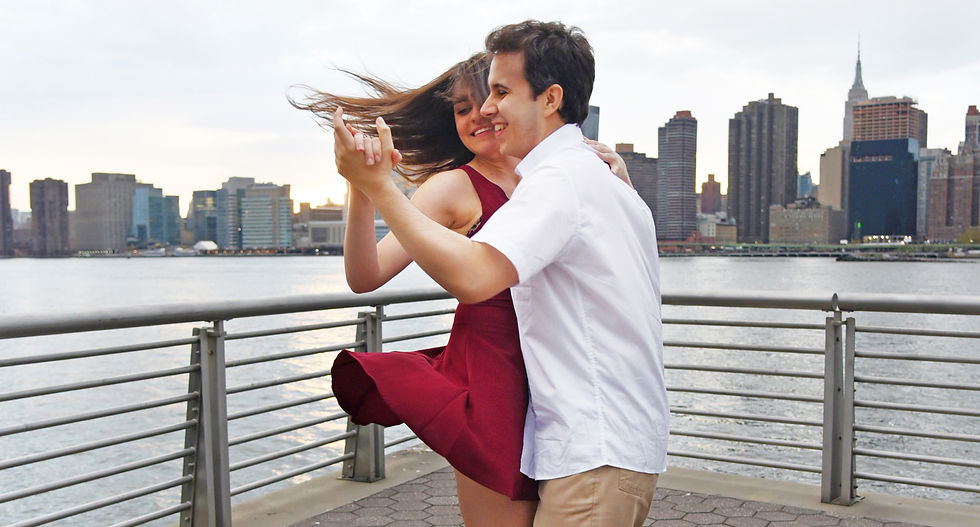
When someone asks what forró universitário is in dance, the natural assumption is that there must be a clearly defined style, with a specific set of movements that describe it.
But to better understand how it works in practice, it helps to look at where this dance comes from and what has been incorporated into it over time.
Forró universitário maintains a strong continuity with forms of dance associated with forró pé de serra, including simpler structures such as the “two steps to one side, two steps to the other,” with a very direct rhythmic and physical foundation.
That base does not disappear. It remains an important reference. Over time, different communities and approaches expand this vocabulary and reorganize some of these structures, incorporating other possibilities for movement.
The lateral displacement of the “two steps to each side,” for example, tends to be reduced in many approaches, while other bases begin to appear, such as forward-and-back stepping variations that, in some cases, resemble the logic of other partner dances like salsa, but with an execution and movement quality that remain distinctly forró.
From this expansion, the dance begins to organize itself in more varied ways, opening space for different dynamics and pathways of movement, without losing its original reference.

Over the years of teaching and observing different forró contexts, this process of transformation appears consistently.
This development is, to a large extent, connected to urban dynamics and the introduction of forró into dance schools. Gradually, what was once simpler expands in vocabulary, without losing its base.
If you want to understand how this process unfolded in a broader context - including music and social environments - you can explore this article:
The Foundation of Forró Universitário: Simplicity That Expands
Even with all these transformations, forró universitário maintains a relatively simple foundation. The three-step structure with a pause remains, in many contexts, an important organizing element, aligning dancers’ movement with the rhythmic base of the zabumba. This is what anchors the dance and maintains its connection to traditional forró.
From this base, the dance stops being just repetition and becomes a structure for building.
In some approaches, this expansion goes even further, with sequences that move beyond the traditional structure, incorporating patterns with five, seven, or more steps. This does not replace the base, but expands the vocabulary.
Spins, Transitions, and Circularity in Forró Universitário
One of the characteristics frequently associated with forró universitário is the incorporation of spins, especially in more open positions, which transforms the dynamics of the dance.
In the video below, these elements appear clearly in practice. Notice how spins are combined with moments in closed position, the fluidity of the body language, and the sense of circular movement.
This demonstration took place at the end of a beginner workshop in Philadelphia on Halloween, during a short tour in the United States alongside guest instructor Alice Rodrigues.
The video captures this moment - a connected, fluid, and comfortable dance, incorporating traveling movement and cycles of spins.
It is precisely this type of organization, based on spins, transitions, and continuous flow, that, in many contexts, shapes an important part of the identity of forró universitário in dance.
Body Movement in Forró Universitário: Trends and Variations
There is an element that helps identify an important tendency within forró universitário: body movement.
One frequent visual characteristic of Forró Universitário appears in the use of the arms. Because many spins and position changes happen in open position, the arms actively participate in leading and can accompany and trace these movements through space.
Body movement, however, varies considerably. In some approaches, the dance shows greater fluidity in traveling movements, a looser body, and a sense of lift. In others, the movement may be more marked, contained, and closer to the ground.
In some approaches to Forró Universitário, the person being led often dances with a more elevated body, frequently on the balls of the feet, creating a lighter and more elastic quality of movement.
But it is important to understand that this is not a universal characteristic.
Within forró universitário itself, there have always been different ways of working with the body. What we observe in practice is a tendency, not a rule.
Over the years, dancing and teaching in different contexts, this variation becomes very clear. At festivals, especially outside Brazil, where different teachers and approaches come together, it is possible to observe how these qualities appear with very different intensities.
Some approaches strongly emphasize lightness in the arms, with almost no counterbalance and a looser quality of movement. Others make greater use of counterbalance, creating a different dynamic in the connection.
Similarly, some approaches work with a more elongated and elevated body, while others maintain a closer relationship with the ground, with less lift and greater stability.
All of these approaches coexist within what is called forró universitário.
This diversity does not weaken the style. On the contrary, it reinforces the idea that it is not a single way of dancing, but an open field where different body approaches develop from the same foundation.
If you’re looking for a broader understanding of how these elements fit within the overall structure of forró as a partner dance - beyond the specific context of universitário - I explore that in more detail here:
To observe how these qualities appear in practice, the video below shows a demonstration from a workshop on connection and creativity in dance in New York, alongside guest instructor Milena Morais, before the pandemic.
As you watch, it becomes clear how these elements integrate.
The alternation between moments in close embrace, with a comfortable and connected hold, and more open positions, using space and movement, happens fluidly throughout the dance.
The body tends to remain light, with a sense of lift and elasticity, opening space for creativity and dialogue between partners.
More than illustrating a single way of dancing, the video highlights this openness - one possibility among many within forró universitário.
Forró Universitário and Other Forró Styles: What Changes in Practice
Comparing forró universitário with other forró styles helps clarify its characteristics.
In forró eletrônico, the dance tends to involve less traveling across space and fewer position changes between partners. The focus is on body isolations, especially in the hips, with sharper accents and faster, more localized movement, creating a more concentrated energy.
In Forró Roots, the dance tends to place greater emphasis on closed position, walking patterns, legwork, and a body movement that is often more connected to the ground. Some of these dynamics may resemble elements found in dances such as Samba de Gafieira or Tango, without necessarily indicating direct influence or lineage.
This does not mean that roots is limited to closed position. There are also moments in open position and a variety of spins that develop within that context. The difference lies more in how frequently these elements appear and in their overall character within the dance.
Similarly, Forró Universitário should not be understood simply as a dance in open position. An important part of its language lies precisely in the alternation between open and closed positions.
For this reason, reducing the difference between Universitário and Roots to the idea that one is danced “open” and the other “closed” is an oversimplification. Both can use close embrace, spins, traveling movements, and different degrees of proximity. What changes is the frequency, function, and way these elements are organized within each approach.
It is common to find close, connected dancing with a simple base, marked by comfort, flow, and quality of embrace. This “chamego” is as much a part of the experience as spins.
The difference lies in how the close embrace is used in each style. In roots, it often serves as a base for walking patterns, locks, shared spins, leg actions, and variations in stepping. In eletrônico, it connects more to groove and hip movement. In forró universitário, it often becomes a space for comfort, pause, and connection quality.
Conclusion: An Expansion of the Base, Not a Rupture
Forró universitário in dance does not represent a complete break, but rather a continuity in transformation. It maintains the foundation of traditional forró while expanding its organizational possibilities, incorporating new influences and movement ideas.
In a conversation I recorded for the Forró New York YouTube channel with instructor Vitinho Maia from Brasília - one of today’s leading educators in forró dance - an interesting perspective emerged. In his view, what we call forró universitário in dance can be understood as an updated version of forró pé de serra.
Perhaps it is precisely this continuity - more than a rupture - that helps explain why forró universitário is at the same time so recognizable and so open to different interpretations.
In the video below, we explore this idea further, discussing different forró styles in both music and dance.
If you would like to understand the broader context of forró - including its origins, musical structure, and cultural significance - you can explore this article:
Frequently Asked Questions About Forró Universitário in Dance
Is forró universitário a specific dance style?
Not exactly. Forró universitário is not a closed style with fixed rules, but a way of dancing that develops within a broader cultural movement tied to the expansion of forró in urban contexts.
In this process, the dance incorporates and develops new possibilities for movement and body organization, especially through spins and traveling movements. Some of these characteristics also appear in other social dances, but within forró they take on forms of their own.
What are the main characteristics of Forró Universitário dance?
Forró Universitário maintains the rhythmic foundation of traditional forró while expanding its movement vocabulary. Among its most common characteristics are spins and position changes, the alternation between open and closed positions, and a wide variety of combinations between these elements.
The frequent use of spins in open position also gives the arms a more active and visible role, accompanying the lead and tracing movements through space. Body movement varies considerably between different schools and dancers: some approaches are lighter, more fluid, and looser, while others use more marked and contained movements.
These characteristics are tendencies, not rules. Different schools, teachers, and communities have developed distinct ways of dancing Forró Universitário.
What is the difference between Forró Universitário and Forró Roots?
The main difference lies in how each approach organizes its movement vocabulary. Forró Universitário tends to feature a greater variety of spins and combinations in open position, while Roots tends to give more space to walking patterns, legwork, variations in stepping, and movements developed in closed position.
This difference also appears in the use of the arms. In Universitário, spins in open position often cause the arms to accompany and trace the movement, opening outward or rising during different combinations. In Roots, the arms tend to remain closer to the body and more contained, although they continue to play important roles in connection, leading, counterbalance, and spins.
This does not mean that Universitário is an “open” dance and Roots a “closed” dance. Both use embrace, spins, traveling movements, and different degrees of proximity. What changes is the frequency, function, and way these elements are organized within each approach.
Forró Roots is often associated with a development that, in many contexts, takes place within the broader universe of Forró Universitário. Initially, dancers already practicing Universitário begin incorporating other elements and reorganizing their body language, contributing to the development of new ways of dancing.
Over time, these approaches become more established and increasingly differentiated, until Roots develops an identity of its own. Today, Universitário and Roots can present quite distinct languages, while still sharing references and a history of development that intersects across different moments and contexts.
This is not a matter of one style being simpler or more complex, but of differences in emphasis, vocabulary, and movement organization.
What is the difference between forró pé de serra and forró universitário in dance?
Forró universitário maintains a strong continuity with forms of dance associated with forró pé de serra, while expanding its movement vocabulary through a greater variety of spins, position changes, traveling movements, and forms of connection.
In practice, this boundary is not always clear. Many people also use “pé de serra” to refer to what is now danced as forró universitário, understanding this form as a continuation or update of the style.
This reveals an important point: the term “forró universitário” makes more sense as a description of a cultural and musical movement than as a rigidly defined dance style. The way of dancing can exist independently of the musical repertoire, showing that these classifications are, in part, simplifications of a more complex process.
Is forró universitário always danced in open position?
No. Despite the frequent presence of spins and traveling movements in open position, an important part of Forró Universitário also takes place in closed position, with the partners dancing together in an embrace.
In open position, there is space between the partners’ bodies. They may maintain connection through their hands or, at certain moments, even release that contact. Alternating between open and closed positions is common in Forró Universitário.
Do you need to know many steps to dance forró universitário?
No. The foundation remains simple. What changes is how that base can be expanded over time, allowing the vocabulary to grow gradually.
If you would like to understand this foundation more clearly and start building your dance step by step, you can explore my online course for beginners. It includes over 10 hours of structured content designed to help you practice from wherever you are.
My own foundation as a forró dancer was built within this movement. I learned and developed my dance during this period of transformation, which continues to shape how I teach and understand forró today.
And if you are in New York City, you can also join us in person. I teach weekly classes where we work on these same principles - from the base to more developed forms of movement, always with a focus on connection, musicality, and social dance.
Does Forró Universitário have a single technique?
No. Different schools, teachers, and communities have developed distinct ways of organizing posture, connection, spins, counterbalance, and movement.
There are shared tendencies, but no single technical system that defines all of Forró Universitário. This diversity helps explain why dancers identified with the same style can present very different body movement, vocabularies, and forms of connection.
If you want to go deeper into one of these aspects - especially musicality, which is a central part of my work - you can read:
ABOUT THE AUTHOR
Rafael Piccolotto de Lima is the Founder and Educational Director of Forró New York, as well as a Latin Grammy-nominated composer, arranger, and music director.




Comments