

What Is Forró Dance? Rhythm, Connection, and How the Dance Actually Works

Updated: Jul 9
Forró dance is a Brazilian partner dance structured around a very specific relationship between rhythm, body connection, and movement.
If you are searching for what is forró dance, it is not enough to think in terms of steps or figures. What defines the dance is how movement is organized in time, how partners relate through the body, and how the dance responds to the music.
For a broader understanding of forró as music, culture, and social practice, you can start here:
Forró as a Living and Evolving Dance
Before going further, I think it’s important to say that forró dance is not something fixed or easily contained in a single definition. It is a living, organic practice that has developed in different regions of Brazil in different ways, shaped both by local cultures and by the evolution of the music itself. As new musical subgenres emerged, they naturally influenced how people danced, and over time, different approaches and characteristics began to take form depending on where and how the dance was being practiced.
Because of that, any attempt to define forró dance in absolute terms tends to fall short. What I’m trying to do here is not to create a closed definition, but to offer a broader perspective - highlighting structural elements and recurring characteristics that appear across many of these approaches. Think of this as a point of entry: a way to understand the foundations of the dance while keeping space open for its diversity.
Along the way, I’ll also point to other pages where I go deeper into specific substyles, so you can explore how these differences actually show up in practice.
Rhythmic Structure: Three Steps and a Pause
At the core of forró dance is a binary rhythmic structure with a particular phrasing.
Rather than a continuous sequence of evenly spaced steps, forró is often organized as three steps with a clear difference in duration between them. The first two steps tend to be shorter and quicker, while the third step is longer, allowing the movement to settle before the next cycle begins.
This creates a pattern where movement is not constant, but articulated. The most important weight transfer typically happens on that longer step, which ends up defining the phrasing of the movement and how it connects to the music.
What is sometimes described as a “pause” is not necessarily an absence of movement, but a result of this longer timing. It can feel like a moment of suspension, or simply a continuation of movement without adding new steps.
Relationship to the Music
This rhythmic structure is often taught in relation to the zabumba.
In many traditional patterns, especially in xote, the three steps align with characteristic accents of the drum.However, this should be understood as a guiding reference, not a strict rule.
Musicians vary how they play.
As a result, dancers do not simply “follow” the instrument.They develop a sense of phrasing that remains stable even when the music changes.
In my teaching practice, both in weekly classes and private lessons, especially with beginners, I often use slower and medium-tempo xotes where the zabumba is clearly articulated.This makes it easier to perceive how movement relates to the rhythm before dealing with more complex musical variations.
If you’re interested in going deeper into how this sense of musicality develops over time, I’ve written a more detailed reflection on how it evolves in partner dancing.
And if you’d like to work on this more directly, with structured exercises and guided practice specifically applied to forró, you can also explore my complete online musicality course.
The Movement Foundation
In practical terms, forró is built on a small number of fundamental movement patterns.
In the way I structure teaching, these include:
a simple weight transfer in tempo (balanço)
a lateral base (often associated as a simplified version of the so called “dois pra cá, dois pra lá”)
a back step that supports turns and directional changes
a forward and backward axis
I’ve put together a video on YouTube where I explain these foundations in more detail, demonstrate how they work in practice, and guide you through a short dance-along exercise so you can start feeling them in your own body. You can watch it below.
These are not isolated “steps,” but frameworks for organizing movement. From them, dancers begin to develop turns, directional changes, variations, and transitions between positions.
The dance grows from recombining these elements, not from memorizing long sequences.
All of these foundational concepts can be trained directly. I’ve organized a set of video classes where these base movements, timing, and coordination are explored progressively, in a way that allows the body to absorb the structure of the dance over time.
If you’d like to work on these fundamentals in a more structured way, you can explore them here:
Connection: A Full-Body Structure
One of the most defining aspects of forró is how connection works.
In forró, leading happens primarily through the structure of the body, distributed across the entire frame, not through isolated arm actions.

This creates a type of communication that is continuous, shared, and physically integrated.
This becomes especially clear when working with dancers who come from other styles. A common adjustment is moving away from arm-driven leading toward a connection that involves the torso, the center of mass, the organization of weight shifts, and a clearer sense of spatial intention.
As this shift happens, the dance starts to feel less like movement being “sent” from one point to another, and more like something that emerges from the relationship between both bodies.
Embrace and Proximity
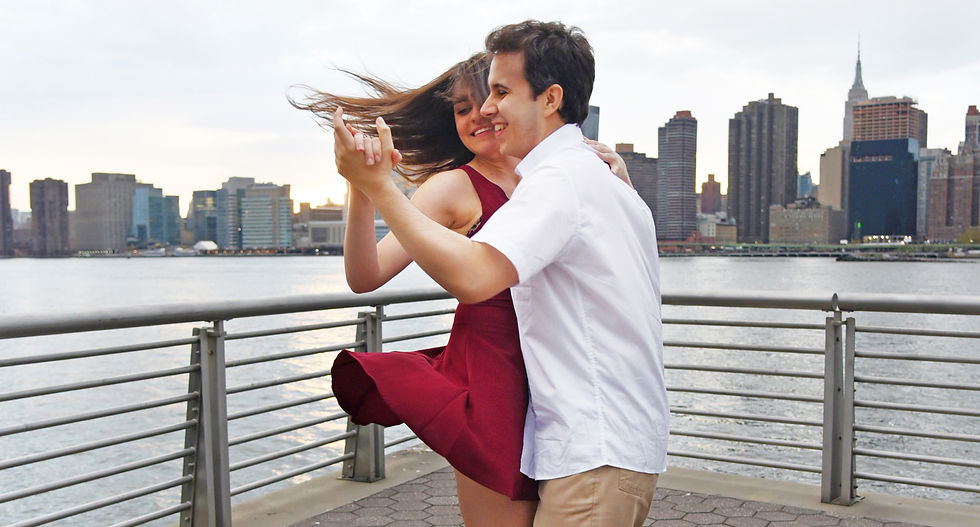
Forró is typically danced in close proximity. The embrace is not only about the upper body. It often extends through the chest, torso, hips, and thighs, with very close foot placement. This creates a compact structure where both partners move as a unit.
This becomes clearer when compared to other dances. In salsa, there is often more space between the bodies, with connection relying heavily on the arms. In tango, connection is often more concentrated in the upper body, with greater separation in the lower body.
In forró, the connection tends to extend through the whole body, creating a more unified sense of movement. At the same time, the embrace is not rigid. It remains adaptable and responsive, constantly shaped by the interaction between partners.
Below is a video recorded with Carol, who taught with me for a period here in New York (2018), during an informal practice where we were exploring different aspects of the embrace in forró and some of the qualities often associated with what many dancers refer to as chamego. We are dancing to a xote, one of the main rhythms in forró, typically slower in tempo and often carrying a softer, more lyrical musical character.
In this example, it becomes easier to observe how the embrace extends beyond the upper body and organizes the movement as a shared structure, while also remaining flexible and constantly adjustable. The embrace is not fixed, but a creative space within the dance, where proximity, weight, and intention shift over time, allowing the interaction between both bodies to shape how the movement unfolds moment by moment.
Use of Space and Different Approaches
Forró does not operate within a single spatial logic. Different styles emphasize different ways of moving through space.
Universitário, especially as it developed in São Paulo, often leans toward more circular movement. Some variations introduce more linear pathways and side changes.
Roots tends to combine circular and linear elements, with a strong use of diagonals and frequent shifts in direction.
Other forms, such as Eletrônico or Piseiro, may emphasize less traveling and more movement in place.
Because of this, forró doesn’t settle into a fixed system. It keeps shifting and adapting as it is danced.
In practice, spatial choices depend on multiple factors, including the style being danced, the music, the partner, and the environment. These elements interact constantly, shaping how movement unfolds in real time.
In my experience teaching, especially through private lessons, I often see how different dancers are naturally drawn to different aspects of the dance. Some are more interested in musicality, others in connection, and others in movement vocabulary or structure.

This variation is not only expected, but part of how the dance develops in each person. Over time, dancers tend to deepen the aspects they connect with the most.
If you’re curious about how these different learning paths tend to unfold in practice, I explore that in more detail here:
If you want to explore these stylistic differences more directly:
Common Challenges
For beginners, one of the main difficulties is not technical, but relational. The proximity of the dance asks for a certain comfort with physical closeness, a growing awareness of the partner, and a different sense of spatial orientation than what many people are used to.
For dancers coming from other styles, the challenges tend to show up in different ways. It is common to rely too much on the arms instead of developing a fuller body connection, to maintain a more open frame than the dance really supports, or to approach the dance as a sequence of moves rather than as a continuous interaction.
These adjustments do not happen all at once. They unfold over time, involving both physical adaptation and a gradual shift in how the dance is perceived.
If you are based in New York City and considering starting, I’ve written a more detailed overview of what that first experience tends to feel like, and how classes are typically structured:
What Holds the Dance Together
Because forró is flexible and diverse, it is difficult to define it through strict boundaries. It becomes clearer when we look at the elements that tend to remain present, even as individual expression varies.
As long as the dance is grounded in forró music - or in closely related genres with a similar rhythmic structure - and the movement reflects a body language and vocabulary connected to the traditions of the style, it remains recognizable as forró.
Within that frame, there is space for personal interpretation, stylistic variation, and the inclusion of new elements. What matters is that this underlying relationship to the music and to the movement language is still present.
Final Thought
Forró is not something you can reduce to a fixed vocabulary or a single technique. It takes shape in the way rhythm, body, and connection interact in real time.
There is a simple structure at the beginning, but what emerges from it depends on how dancers relate to each other and to the music as it unfolds.
If you’d like to see how all of this shows up across different dancers and styles, I’ve put together a YouTube series where I watch and comment on forró videos from a wide range of instructors and dancers. It’s called Forró Video Reacts, and it’s a way of exploring the diversity of the dance through real examples.
I’ve also selected a video below as a starting point. It’s a compilation of excerpts from different dances, so you can get a direct sense of how varied forró can be in practice.
Before watching, it’s worth keeping in mind that many of these clips come from performances or class demonstrations. They tend to be more dynamic, more elaborate, and sometimes slightly more performative than what you’ll typically find in a social dance setting, where movement is often more contained and shaped by the shared space and connection. Even so, they offer a rich entry point into the range of possibilities within forró.
Frequent Asked Questions (FAQ)
What is forró dance?
Forró dance is a Brazilian partner dance based on a binary rhythmic structure, close-body connection, and continuous interaction between partners. It is defined less by fixed steps and more by how movement, timing, and connection are organized in relation to the music.
How is forró dance different from other partner dances?
One of the main differences is the combination of close embrace and full-body connection. In forró, leading is distributed through the body rather than driven primarily by the arms, and movement is shaped by a rhythmic pattern that includes three steps and a pause, rather than continuous stepping.
Is forró dance always danced close?
Most of the time, yes. Forró is typically danced in close proximity, with contact through the torso and often the lower body as well. There are moments of opening for turns and variations, but the dance is generally defined by a close and connected embrace.
Is forró dance hard to learn?
The basic structure is relatively simple, and beginners can start moving with just a few fundamental patterns. However, developing sensitivity to connection, timing, and musicality takes time and experience.
If you want to explore this in more detail:
Do you always follow the same step pattern in forró?
No. While there is a common underlying structure based on three steps and a pause, dancers vary how they interpret timing and movement. The dance allows flexibility, as long as the relationship to the music and the connection between partners is maintained.
What is the basic rhythm of forró dance?
Forró is typically structured in a binary rhythm with a pattern of three steps followed by a pause. The main weight transfer often happens on the longer step before the pause, creating a phrasing that is different from dances based on continuous stepping.
Do I need a partner to learn forró dance?
No. While forró is a partner dance, many aspects can be practiced individually, especially rhythm, coordination, and body awareness. Partner work becomes more important as you develop connection and interaction.
Where can I learn forró dance?
If you’re interested in learning, there are different ways to start depending on your goals.
If you prefer a structured approach that you can follow at your own pace:
If you are in New York City and want to learn in person:
If you are looking for a more personalized approach:
ABOUT THE AUTHOR
Rafael Piccolotto de Lima is the Founder and Educational Director of Forró New York, as well as a Latin Grammy-nominated composer, arranger, and music director.



Comments