

When a Dance Feels Like More Than a Dance

Updated: 3 days ago
What Belongs to the Dance - and What Belongs to Us?
A few days ago, I was having a conversation with a dancer friend about attraction, intimacy, relationships, and the strange things that sometimes emerge through social dancing.
At some point, the conversation arrived at a question that lingered in my mind long after we moved on to other topics.
If dancing with someone feels extraordinary, does that actually mean something beyond the dance itself?
Or does it belong entirely to the dance?
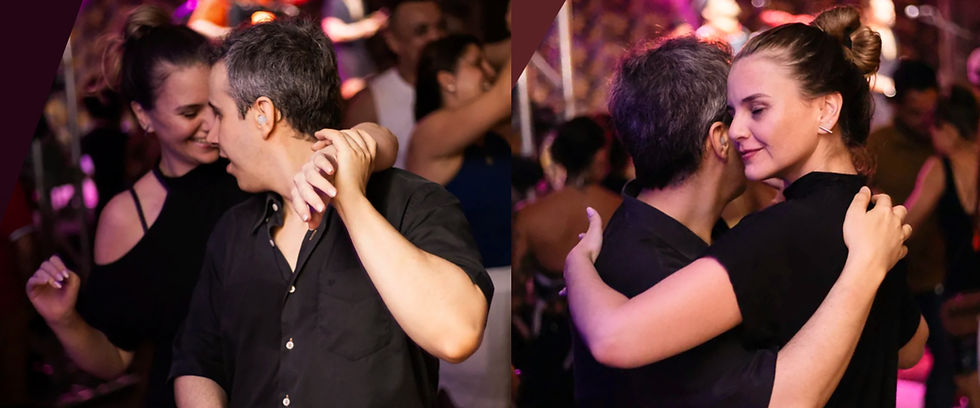
Most people who spend enough time in social dancing have experienced moments that seem difficult to explain. A dance feels unusually comfortable. An embrace seems to fit naturally. Trust appears almost immediately, and a conversation begins to unfold through movement long before words become necessary.
When the music ends, a question often remains:
What exactly happened between us?
The Problem With Easy Answers
The simplest explanation is that none of it means very much.
Music creates emotion. Movement creates connection. Social dancing simply gives those experiences a place to happen.
That explanation has always felt incomplete to me.
After more than twenty years of dancing, teaching, organizing events, and watching thousands of interactions unfold, I've seen too many experiences that refuse to fit so neatly into it.
If every meaningful feeling came only from the structure of the dance, then memorable dances should be fairly interchangeable. But they aren't. Most are enjoyable. Some disappear from memory before the next song begins. And every so often, one stays with you for years because something about the other person felt unmistakably different.
A Connection That Existed Inside the Dance
Many years ago, when I was still relatively new to social dancing, I became close friends with a dancer I deeply admired. She had been part of my own journey into dance, someone who made me feel welcome as I was learning, and perhaps because of that I always approached our friendship with a certain respect that kept romantic possibilities at a distance in my mind.
For more than a year, though, we danced together constantly. We would find each other at different events around town, and something particular seemed to happen whenever we danced. There was an ease in the embrace, a playfulness, a warmth in the way we moved together. Sometimes her hand would move higher on my back, closer to my neck. Friends noticed the chemistry and occasionally teased us about it.
The warmth wasn't limited to the dance floor. There was always affection when we met and when we said goodbye. Still, I never quite allowed myself to interpret any of it as romantic.
Until one day she did.
We were at an event when she turned to me and, almost casually, asked: "Rafa, have you ever wondered if we would work together? What would happen if we kissed?"
I remember being caught completely off guard. I told her that I felt an enormous connection with her, but strangely, I had never really let myself think about us that way.
"What if we tried?" she asked.
We laughed, changed the subject, returned to the ambiguity of the evening. But the question was already there between us. Eventually we kissed, and for a brief period we allowed ourselves to explore what had seemed so obvious to everyone watching us dance.
And that was when something unexpected happened.
The affection was there. So were the trust, tenderness, and companionship. But the sensuality that seemed almost effortless when we danced did not appear with the same intensity when we kissed. In some strange way, our dances had carried more tension, more flirtation, more heat than the romance that grew out of them.
It never developed into a relationship. Before long, we returned to being friends, and we remain friends to this day.
For years, that experience stayed with me because nothing about the dance had been false. We really did share an unusual intimacy. We had simply mistaken the kind of intimacy it was.
That distinction would take me years to fully understand.
When the Same Qualities Continue Outside the Dance
Years later, I met someone who gave me almost the opposite experience.
She knew very little forró. I remember our first dance partly because almost nothing happened in it. There were hardly any turns or recognizable pieces of forró vocabulary. We mostly stayed in place, dancing to the beat, shifting our weight, listening to the music and to each other.
And somehow, that was enough.
There was a presence in that dance that caught my attention immediately. Without much movement to occupy us, there was nowhere for either of us to hide. We were simply standing close to each other, listening and responding.
Afterward, we kept talking. Eventually we made plans to have dinner together.
When we left the restaurant that evening, we were still talking beside the car in the parking lot. At some point, instead of saying goodbye, we put on a song.
And we danced again.
There was no dance floor this time, no social around us, no room full of other couples. Just the two of us beside a parked car, moving to music coming from its speakers.
That dance ended in a kiss.
We continued seeing each other afterward, this time as romantic partners. And what had first appeared in an almost motionless dance continued naturally into the rest of our time together: the same curiosity, warmth, attraction, and pleasure in being close.
The first experience had taught me that extraordinary chemistry in a dance could remain specific to the dance. The second experience suggested something different: sometimes the dance reveals a connection before we know how to name it.
The Experiences That Remain Unanswered
And then there are connections I still don't know how to interpret.
There are people I have danced with for years with whom I share a remarkable sense of ease. We may spend an entire song with our eyes closed, completely comfortable in the embrace, playful in one moment and quiet in the next. There is trust, attention, and a willingness to surrender to the dance that can feel surprisingly intimate.
And then the song ends.
We thank each other, return to the room, and nothing else happens.
No one has ever tested the boundary, so there is no story about what happened afterward. I don't know whether the connection would disappear outside the dance, as it did in my first story, or continue naturally, as it did in the second.
Perhaps there is no romantic attraction at all. Perhaps there is, but neither person wants to risk changing something beautiful inside a relatively small dance community. Perhaps the timing has never been right. Or perhaps the dance itself provides exactly the amount of intimacy that both people want from each other.
I genuinely don't know. And perhaps I never will.
What Belongs to the Dance?
Looking back, I think all three experiences taught me the same lesson.
The connection itself was never the illusion.
The difficult part was understanding what kind of connection it actually was.
The first dance revealed an intimacy that turned out to be deeply affectionate without becoming romantic. The second revealed a relationship that was already beginning before either of us knew it. The third may contain either possibility, but neither of us has ever stepped far enough outside the dance to find out.
That is why I no longer think a remarkable dance is simply an illusion created by music and movement.
But neither do I think it is proof that two people are meant to be together.

Sometimes the dance is pointing toward a relationship.
Sometimes it isn't.
And sometimes the dance itself is the fullest expression of the connection that will ever exist between two people.
Continue Exploring
Why do closeness and trust emerge so naturally in partner dancing? Explore the balance between intimacy, respect, and personal boundaries on the dance floor.
Discover why dancing creates forms of connection that often feel deeper, more immediate, and more memorable than everyday interactions.
Some of the most important things we discover through dance have little to do with steps. Explore how partner dancing reflects communication, vulnerability, and human connection.
Take Your Next Step with Forró New York
Whether you're looking to start dancing, connect with the local community, or deepen your understanding of forró, there are many ways to explore and learn with us.


ABOUT THE AUTHOR
Rafael Piccolotto de Lima is the Founder and Educational Director of Forró New York, as well as a Latin Grammy-nominated composer, arranger, and music director.


Comments