

Reciprocity in Social Dancing

Updated: Jun 9

Reciprocity Matters More Than Rules
One of the most important ideas I’ve developed over the years dancing forró is that there is probably no universally correct level of intimacy, proximity, energy, complexity, expression, or even relational dynamic in social dancing.
What matters is reciprocity.
Partner dancing is, by nature, an activity built on direct human connection. There is physical proximity, constant bodily communication, exchange of energy, listening, adaptation, and emotional presence. Because of that, social dances have historically always carried dimensions of intimacy, sensuality, flirtation, affection, and human encounter.
This is not a deviation from social dancing.
It is part of its nature.
At the same time, I understand why many conversations today emphasize safety, boundaries, and respect inside dance spaces. These are important concerns. But I also think problems begin when we try to reduce social dancing to rigid formulas about what should or should not happen between two people on the dance floor.
The more I dance, the more I feel that the same exact movement, embrace, level of proximity, or emotional dynamic can feel beautiful in one interaction and deeply uncomfortable in another. What changes is not necessarily the action itself, but the reciprocity surrounding it.
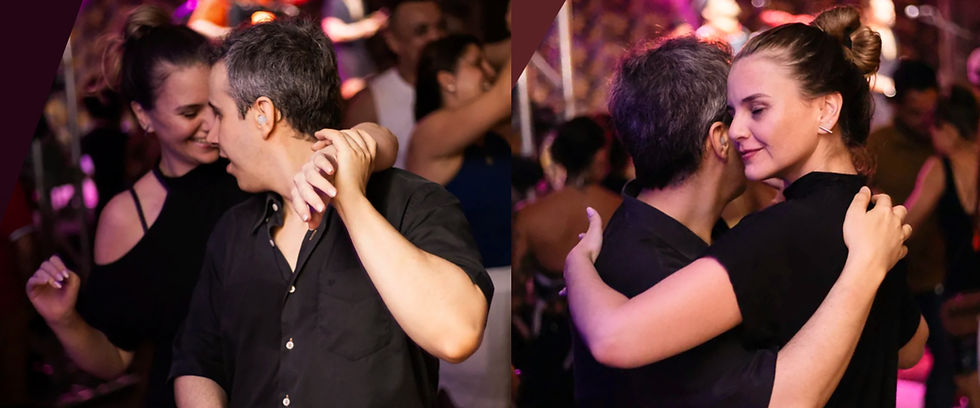
Two dancers may create an extremely sensual, affectionate, and physically intimate dance, full of closeness, softness, touch, eye contact, and emotional presence. From outside, it may almost look like a romantic interaction unfolding publicly. And yet, for those two people, the experience may feel completely natural, mutual, joyful, and welcome.
At the same time, another dance may be much more distant, technical, and restrained, with very little physical intimacy involved, and still create discomfort because one of the dancers feels that certain gestures, intentions, or dynamics are not desired in that context or coming from that particular partner.
The problem is not desire. The problem is imposing desire.
That is why I believe the central question is not how much intimacy, sensuality, or connection should or should not exist in social dancing.
The real question is whether both people genuinely want to move in the same direction together.

Social Dancing as Mutual Discovery
And this goes far beyond intimacy.
The same principle applies to musicality, physical energy, complexity, body language, creativity, style, or the relationship between leading and following. Every dancer carries personal preferences, tendencies, and ways of experiencing the dance. I certainly have mine. In many situations, I naturally prefer a more grounded, fluid, connected, and musically integrated dance. Other dancers may prefer more explosive energy, stronger physical intensity, more visual expression, or more independent movement.
None of these tendencies are inherently wrong.
What creates tension is usually not difference itself, but the inability to find a shared dynamic together.
And interestingly, our own preferences are not even fixed. They change depending on the music, the person, the emotional context, the environment, and the connection being created in that specific moment. A type of dance that may not feel natural to me in one context may suddenly feel wonderful in another because the interaction itself invites it organically.
This is why I sometimes think social dancing works through small invitations constantly being answered - or not answered - in real time. A shift in energy, proximity, musicality, physicality, or emotional tone can gradually reshape the entire interaction between two people.
Without invitations, nothing new happens in the dance. But beautiful social dancing depends on the ability to perceive how those invitations are being received, reciprocated, transformed, or sometimes gently declined.
Good social dancers learn to perceive these responses with sensitivity. They understand that social dancing is not about imposing a personal ideal of what the dance should be, but about discovering together what kind of interaction makes sense for those two people during the duration of a song.
Listening to the Other Person’s Body
Recently, this became very clear to me during a class.
One student was dancing extremely close to his partners while maintaining an intense and fixed gaze during the entire dance. Some partners visibly looked away and slightly reduced the proximity between their bodies. He continued exactly the same way for several songs, apparently without perceiving those reactions.
I intervened, not to criticize his desire for connection, but to help him understand the importance of perceiving the response of the other body.
The invitation itself was not the problem.
The inability to perceive the lack of reciprocity was.
And maybe this is one of the most beautiful things about social dancing.
When we learn to listen to the other person’s body, the dance stops being a field of rigid rules and becomes something much more alive: a continuous dialogue where two people gradually discover, together, how they want to experience that moment.
Many of these ideas also connect to broader reflections about intimacy, attraction, trust, boundaries, and social interaction inside partner dancing:
ABOUT THE AUTHOR
Rafael Piccolotto de Lima is the Founder and Educational Director of Forró New York, as well as a Latin Grammy-nominated composer, arranger, and music director.



Comments