

Why Some Great Dancers Are Not Always Great to Dance With

Updated: Jun 12
What actually makes someone a good social dancer?
One of the strangest things in social dancing is realizing that some very impressive dancers are not always the most enjoyable people to dance with.
And sometimes the opposite also happens.
A dancer may have a simpler repertoire, dance fewer complex movements, and still create a much richer and more memorable experience.
Over the years, I started noticing that this difference often comes from something fundamental: the difference between performative dancing and social dancing.
This is not mainly a question of technique, but of where the dancer’s attention is placed.
Performative Dancing vs Social Dancing
Performative dancing tends to move outward.
Its focus is often visual impact: complexity, vocabulary, precision, presence, showing ability, creating impressive images and moments.
And there is nothing inherently wrong with that. I love beautiful, creative, technically advanced dancing.
But social dancing follows a different logic.
Social dancing tends to move inward.
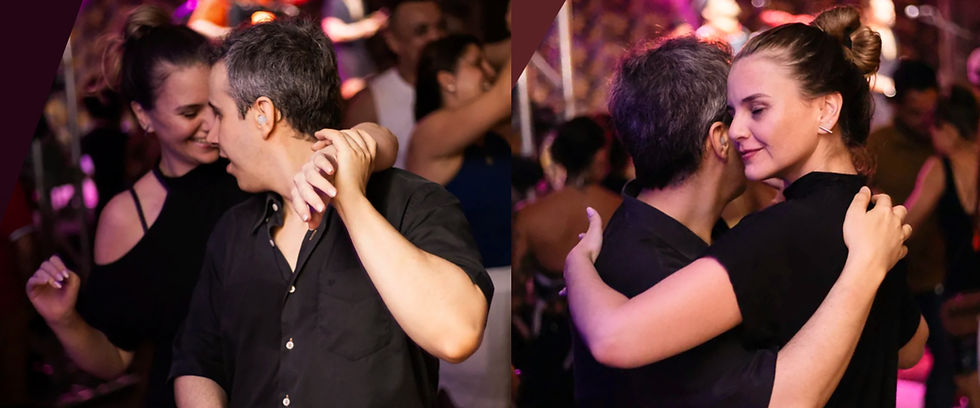
The experience is not centered on how the dance looks from outside, but on how the dance feels for the two people inside it.
Sometimes this connection remains purely social and musical. Other times, attraction, chemistry, flirtation, and emotional presence also become part of the experience. Social dancing exists in this interesting space between movement, music, connection, and human interaction.
Comfort.
Listening.
Adaptation.
Musical connection.
Playfulness.
Generosity.
Presence.
These things are much harder to measure visually, but they completely transform the experience of the dance.
In social dance, what feels good is often different from what looks impressive.
When the Dance Stops Being Shared
Sometimes dancers become so focused on executing movements, maintaining a certain style, or producing a visually impressive result that the experience of the partner becomes secondary.
The dance may look strong from the outside while feeling surprisingly disconnected from the inside.
And this can happen at many different levels, including with highly experienced dancers, teachers, and respected names in the scene.
Not necessarily because they are arrogant or insensitive, but because certain kinds of training and recognition naturally reward performative dancing. Complexity becomes associated with quality. Vocabulary becomes associated with mastery.
Over time, some dancers become less flexible without realizing it.
The result is that the dance may become impressive without becoming especially enjoyable.
And in social dancing, that difference matters.
What Makes Someone a Good Social Dancer
Some of the best dances I’ve ever had were not necessarily the most visually impressive ones.
They were dances where both people seemed genuinely interested in creating something together.
A dance where the embrace could breathe.Where musicality existed in dialogue with the partner instead of competing with the partner.Where movements adapted naturally to timing, space, comfort, and interaction.
A dance where there was room for surprise, listening, affection, creativity, and even silence.
This applies equally to both sides of the partnership.
Leaders can become rigid, over-controlling, and obsessed with executing movements.
Followers can also become disconnected from the shared construction of the dance, focusing only on self-expression or individual interpretation without adapting to the partnership.
In both cases, the same thing gets lost:the feeling that the dance is being created together.
What People Usually Remember
Years later, most people will not remember exactly which movements you did.
They will remember how the dance felt.
Whether the dance felt tense or comfortable.Whether they felt heard or ignored.Whether the dance felt alive or mechanical.
And honestly, I think this realization changed my priorities completely over time.
Today, what interests me the most in social dancing is not complexity by itself, but the ability to create a meaningful shared experience through movement, music, and connection.
Because in social dancing, being good is not only about what people can see from the outside.
It is also about how the dance feels to the person sharing it with you.
ABOUT THE AUTHOR
Rafael Piccolotto de Lima is the Founder and Educational Director of Forró New York, as well as a Latin Grammy-nominated composer, arranger, and music director.



Comments