

What Are the Basic Steps of Forró?

Updated: May 16
This article focuses specifically on the basic step structures of forró - the foundational patterns that organize rhythm, direction, and weight transfer.
If you are looking for a broader beginner roadmap, start with The Beginner’s Checklist for Forró. If you want to understand how these basics expand into turns, transitions, and movement vocabulary, continue with Forró Basic Steps and Movements.
The foundations of forró are surprisingly simple. Most of the dance is built from a small number of rhythmic structures that organize direction, timing, weight transfer, and connection with the partner, long before dancers begin combining movements into more complex sequences and interactions.
At the same time, it is important to understand that forró is not a single standardized dance. Different styles and communities organize movement differently, and there is no single universal “official” basic step shared identically across all forms of forró.
The foundations shown in this article are primarily connected to the structures most commonly used in contemporary forró universitário and forró roots communities, although even forró roots frequently incorporates important variations and adaptations of these basics.
In my classes in New York, I usually teach four main foundational structures. From these basics, dancers gradually develop walks, turns, traveling movements, combinations, and variations.
1. Front-and-Back Basic
This structure moves toward the partner and back again. It became especially common in forró universitário and is one of the most widely recognized modern forró basics.
This movement organizes the dance through a front-and-back axis.
2. Lateral Basic - (“Dois Pra Cá, Dois Pra Lá”)
This structure comes from older pé de serra traditions and organizes movement laterally instead of moving toward the partner.
Many modern classes teach contemporary variations of this same lateral logic.
3. Open Position Base (“Abertura”)
This structure is commonly used in open position dancing and creates the foundation for turns, arm figures, and rotational movements.
Unlike close embrace basics, this movement creates more space between the partners.
4. Single-Time Weight Transfer ("Balanço")
This is the simplest rhythmic structure in forró: continuously transferring weight directly on the pulse of the music.
It is strongly connected to arrasta-pé traditions, but can also appear in modern styles as a groove variation and an accessible entry point for beginners.
How Forró Rhythm Works
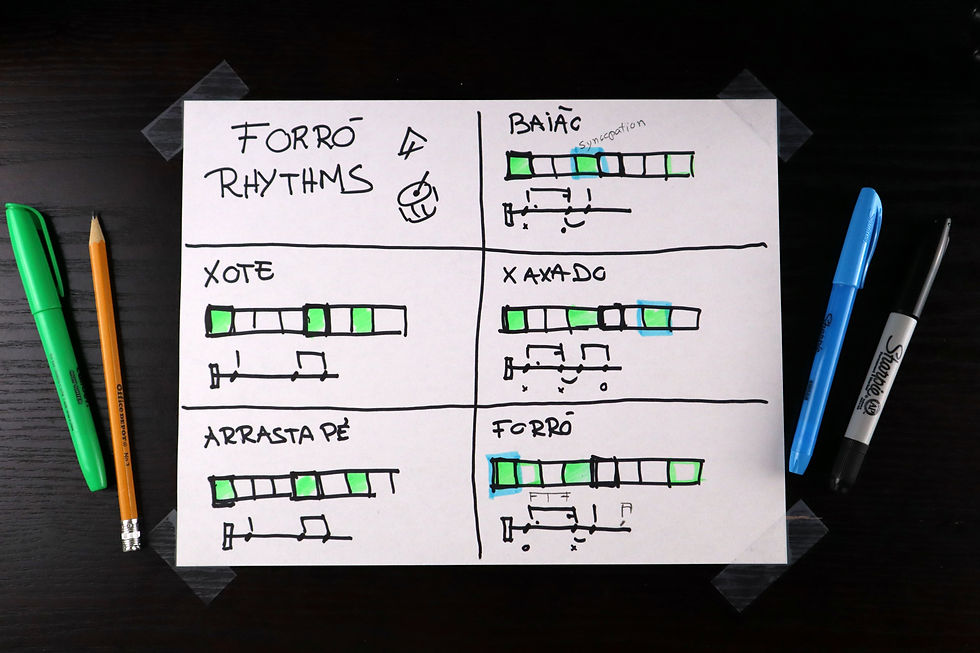
Most traditional forró structures organize three weight changes inside the musical measure.
Some teachers explain this rhythm as:
step - step - step - pause
Another way to understand it is:
one longer weight transfer on the strong beat
followed by two shorter steps on the weaker beat
This second interpretation is closer to how I usually teach rhythm in my classes.
The only structure above that works differently is the single-time weight transfer, which follows the pulse continuously on every beat.
In the article below, I explain in more detail how forró rhythm works and how dancers organize timing and weight transfer inside the music.
The Entire Dance Comes From These Foundations
Walks, turns, traveling movements, rotational cycles, and many partner combinations gradually emerge from these same rhythmic and directional principles.
This is why experienced dancers continue refining these structural foundations for many years, even after developing a much larger movement vocabulary.
Practice the Basics With Me
If you want to practice these movements together with music, I also recorded a longer guided practice session where you can follow the basics along with me step by step.
Want To Continue Learning?
I also prepared a complete beginner online course focused on rhythm, timing, musicality, connection, body organization, and the core foundations of forró.
Below is a short video explaining how the course works, including examples from classes and the structure we use to help students progressively build confidence and comfort in the dance.
Additional Resources
ABOUT THE AUTHOR
Rafael Piccolotto de Lima is the Founder and Educational Director of Forró New York, as well as a Latin Grammy-nominated composer, arranger, and music director.



Comments