

Why Is Attraction Such an Uncomfortable Topic in Social Dancing?

Updated: 3 days ago
A few days ago, I came across a post from a dance teacher arguing that dance communities should move away from being associated with romantic expectations.
More specifically, she was questioning the common tendency to present social dancing as a place where people might meet romantic partners, flirt, or explore attraction alongside the dance itself. While she acknowledged that relationships naturally emerge from dance communities, her argument seemed to be that these possibilities should occupy a much smaller place in how we talk about, promote, and understand social dancing.
The point she was making was not particularly radical. In fact, much of what she said seemed reasonable. She acknowledged that people meet through dance, that relationships emerge from dance communities, and that romantic connections have always been part of these environments. Her concern was that dance should not be presented primarily as a way to flirt, find partners, or pursue romantic interests.
I understood where she was coming from.
As I listened to the conversation unfold, I found myself wondering why the desire to meet someone romantically often seems to occupy a strange place within discussions about social dancing. We are usually comfortable talking about friendship, community, self-expression, exercise, creativity, personal growth, musicality, or cultural discovery. Yet attraction often enters the conversation carrying a certain weight, as though it requires explanation or justification in a way that other motivations do not.
The Motivations We Consider Legitimate
Over the years, I have met people who arrived at forró for every imaginable reason.
Some were looking for a more enjoyable way to stay active. Others wanted a new hobby. Some were drawn to the music and culture. Others had recently moved to a new city and were hoping to build a social circle. Many were simply curious.
All of those motivations seem to be accepted without much hesitation.
Yet if someone openly admits that part of their interest involves the possibility of meeting a romantic partner, the reaction often changes. Not always, but often enough that it becomes noticeable.
Attraction often seems to occupy a different place from other motivations people bring to social dancing. Friendship, exercise, community, culture, and personal growth are usually discussed openly. Attraction, even when acknowledged as a natural part of human interaction, often carries a different kind of scrutiny.
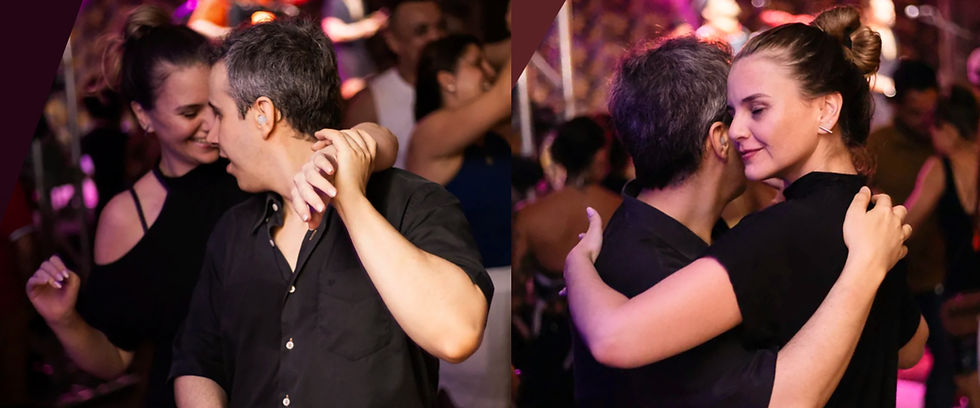
Yet social dancing has never existed exclusively as a technical activity. It has always been a social environment where people gather repeatedly around music, movement, shared experiences, and physical presence. It would be surprising if attraction did not occasionally emerge within that context.

When Dance Becomes Something More
Personally, I have never gone dancing with the sole expectation of finding a romantic connection.
Most nights are simply about dancing.
They are about music, friends, conversation, laughter, learning, and the simple pleasure of being part of a community that I care about.
At the same time, some of the most memorable evenings I have experienced through dance began with a simple invitation to dance.
A conversation emerged naturally. Curiosity followed. Sometimes attraction appeared. Occasionally those encounters developed into relationships, and in a few cases they became important chapters of my life.
What I remember most about those experiences is not that they happened, but how naturally they happened. The dance itself created the conditions for two people to encounter one another in a way that might never have occurred through a dating app, a bar, or a carefully planned social interaction.
The possibility of that happening has always felt beautiful to me.

The Contradiction We Rarely Talk About
Communities often celebrate stories of people who met through dance and eventually built relationships together. We enjoy hearing those stories. We tell them at festivals, weddings, parties, and anniversaries. They become part of the collective memory of the community itself.
Yet there can also be a subtle suspicion toward people who openly acknowledge that they hope something similar might happen to them.
It is as though the outcome is celebrated while the desire remains slightly uncomfortable.
The relationship is considered beautiful once it exists, but the possibility of seeking connection before it exists is treated more cautiously.
A Human Possibility, Not a Community Problem
Respect, consent, and healthy boundaries remain essential to any dance community.
Attraction does not create an obligation, a right, or an expectation that feelings will be reciprocated.
Attraction sometimes appears unexpectedly. Other times, people arrive in a new community genuinely hoping they might meet someone they connect with. I see nothing inherently problematic in either experience.
That is why I continue returning to this question.
Dance communities do not need to revolve around romance.
Still, I sometimes wonder why the possibility of meeting someone through dance, or the simple desire for that to happen, continues to make so many people uneasy.

Take Your Next Step with Forró New York
Whether you're looking to start dancing, connect with the local community, or deepen your understanding of forró, there are many ways to explore and learn with us.


ABOUT THE AUTHOR
Rafael Piccolotto de Lima is the Founder and Educational Director of Forró New York, as well as a Latin Grammy-nominated composer, arranger, and music director.



Comments